
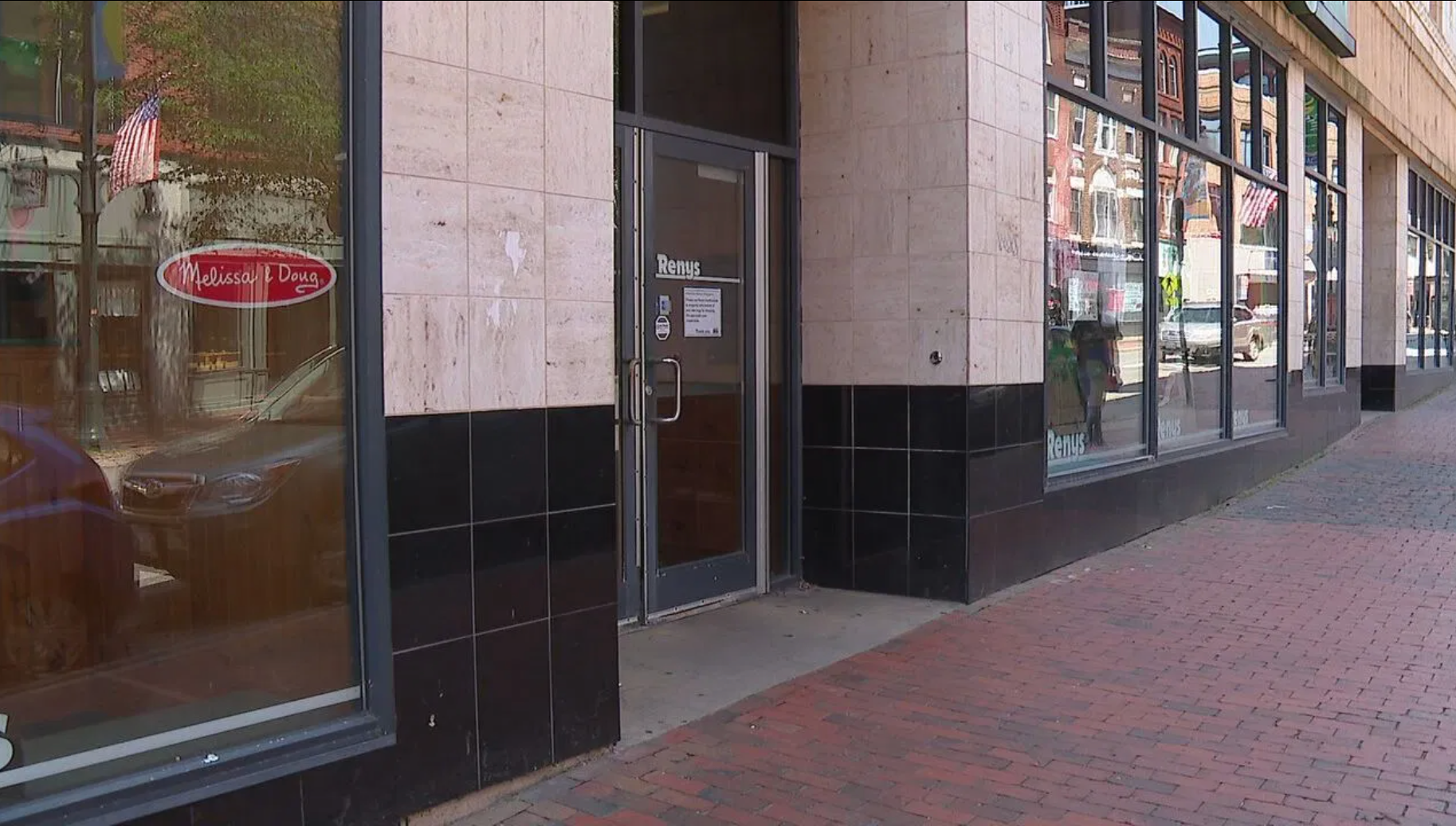
Portland’s Vacant Storefront Ordinance Raises New Questions About Investment, Enforcement, and the Future of Downtown
PORTLAND — On a recent weekday morning, Commercial Street hummed with the usual rhythms of autumn in Maine’s largest city: delivery trucks unloading at the waterfront, tourists with coffee cups snapping photos of Casco Bay, and office workers weaving through construction barriers. Yet just a few blocks inland, a different picture emerges: papered-over windows, “for lease” signs fading in the sun, and buildings whose upper floors are alive with tenants but whose ground-level spaces have sat empty for years.
That tension between a city that’s still growing and a downtown that’s struggling to keep its storefronts filled — lies at the heart of Portland’s new vacant storefront ordinance, a measure adopted this summer by the City Council and signed by Mayor Mark Dion, who joined Councilors Pious Ali, Regina Phillips in voting against the measure.
The new rule will impose fines on property owners who leave ground-floor retail spaces vacant for extended periods, marking a significant shift in how the city intends to address its growing number of empty storefronts.
Under the ordinance, owners of commercial properties in designated business districts will be required to register vacant units with the city. If a space remains unoccupied beyond a set period, typically six months, escalating fines will apply, starting in the hundreds and potentially reaching thousands of dollars annually.
City officials have described the policy as a tool to encourage activation of commercial corridors and reduce blight. However, for many property owners and small-business advocates, the move feels punitive at a time when Portland’s downtown is grappling with a far more complex mix of challenges, including inflation, high rents, public-safety concerns, and a reputation, fair or not, for being a difficult place to do business.
“We’re Being Fined for a Market We Don’t Control”
At the heart of the debate, there is a fundamental question: what’s causing Portland’s storefront vacancies in the first place?
According to the city’s economic development office, Portland’s vacancy rate in the downtown core has hovered around 15 to 18 percent since 2021, even higher than pre-pandemic levels, when it was closer to 8 percent. The city’s new ordinance seeks to “motivate property owners to rent or repurpose space more quickly,” in the words of Councilor Roberto Rodriguez, who sponsored the measure.
However, for landlords like Sarah Connolly, who manages mixed-use properties near Monument Square, the new policy falls short.
“We’re being fined for a market we don’t control,” Connolly said. “It’s not that we’re sitting on empty space waiting for a big national chain. We can’t find tenants who can afford the rent, who can get through permitting, and who feel comfortable opening downtown right now.”
Connolly said she recently had a potential café tenant walk away after seeing a person overdosing in the doorway of the building during a tour. “That’s not something a fine can fix,” she said. “That’s about public safety and confidence.”
Safety, Visibility, and a Shifting Downtown
In recent years, Portland’s downtown has faced increasing scrutiny from residents and business owners over issues of crime, drug use, and homelessness, particularly around the Bayside and Congress Street corridors.
Business groups, such as Portland Downtown and the Greater Portland Chamber of Commerce, have urged the city to take a more proactive approach to addressing street-level disorder, arguing that the visible lack of safety deters customers and investors alike.
“We hear from employers and developers that the number one concern they have isn’t parking or permitting, it’s public safety,” said Cory Morrissey, a member of the Chamber’s economic vitality committee. “You can’t attract tenants to vacant spaces if people don’t feel comfortable walking down the block.”
Mayor Dion, who was elected on a platform emphasizing accountability and order, acknowledged those frustrations but defended the ordinance as part of a broader effort to “restore civic pride and business confidence.”
“Leaving commercial spaces dark for years sends a message that we’ve given up on those blocks,” Dion said in a recent interview. “This ordinance is about changing that perception and encouraging reinvestment.”
Yet many in the business community see a contradiction: the same city government that has struggled to enforce basic quality-of-life laws is now imposing fines on property owners for vacancies that are partly driven by those enforcement gaps.
Investors Watching Closely
The implications of Portland’s new approach may extend far beyond its city limits.
Real estate analysts say the ordinance will be watched closely by investors across Maine and New England, especially since Portland already has some of the highest commercial property costs and tax rates in the region.
“This is an unusual move for a city of Portland’s size,” said Emily Harriman, a Portland-based real estate consultant. “Boston has experimented with similar ideas, but even there, enforcement is rare. For Portland to make this a cornerstone of downtown policy sends a signal — intentional or not — that the city is willing to intervene directly in private market decisions.”
That signal, she said, could spook long-term investors weighing whether to purchase or redevelop downtown properties. “They’ll ask: what happens next? If the city can fine me for a vacancy, will it later cap rents or impose use restrictions? Predictability matters to capital.”
Portland officials counter that the policy simply holds property owners accountable. “We’re not trying to punish anyone,” said Councilor Anna Trevorrow, who voted in favor of the ordinance. “We’re trying to make sure our downtown doesn’t stagnate. A street full of papered-over windows hurts everyone — neighbors, nearby businesses, and the city’s tax base.”
Balancing Intent with Implementation
The ordinance requires property owners to register any ground-floor vacancy lasting more than 90 days and submit a plan to either lease, renovate, or repurpose the space. The city’s housing and economic development department will maintain a registry, conduct periodic inspections, and levy fines that escalate the longer a property remains empty.
Revenue from those fines will go into a “Downtown Activation Fund”, meant to support pop-up retail, art installations, or small business incentives in vacant spaces.
Critics, however, question whether the city has the capacity to enforce yet another regulation effectively.
“The city struggles to staff its code enforcement office, respond to safety complaints, and keep up with inspections,” said Jeff Levine, former Portland planning director and now a lecturer at MIT. “Adding a vacancy registry is symbolically strong, but operationally challenging. It’s one thing to pass a law — another to make it work in practice.”
The Larger Context: High Costs, Tight Margins
Even before the pandemic, Portland’s small business landscape was shifting under the weight of rising costs. Between 2015 and 2023, average downtown commercial rents increased by nearly 40 percent, while property taxes climbed almost 50 percent, according to city data. Add in higher insurance premiums, utility costs, and a new $19-an-hour minimum wage the highest on the East Coast and many operators say the math simply doesn’t add up.
“Margins are razor-thin,” said Maria Alvarez, who owns a boutique on Congress Street. “If I moved out tomorrow, my landlord would probably sit on this space for months trying to find a new tenant who can pay the same rate. That’s not greed…that’s reality.”
Economic development officials acknowledge the pressure but insist the city must take a long view. “If we want vibrant, walkable districts, we need to ensure turnover doesn’t turn into long-term vacancy,” said City Manager Danielle West. “It’s about setting expectations for stewardship.”
Comparing Portland to Other Cities
Cities from San Francisco to Washington, D.C., have experimented with vacant property taxes and penalties in recent years, with mixed results.
San Francisco’s 2020 “Empty Storefront Tax,” for example, imposed escalating fines on landlords who left commercial spaces unused for more than six months. Critics argued that it backfired by pushing small property owners to sell or convert buildings into non-retail uses. Washington, D.C.’s similar law led to some enforcement successes but also to bureaucratic confusion and lawsuits over property classification.
“Portland’s version is more modest,” said Harriman, the real estate consultant. “But it faces the same fundamental tension: are you incentivizing activity or just adding another cost to a market that’s already strained?”
Public Confidence and the Path Forward
For many observers, the vacant storefront debate underscores a deeper crossroads for Portland — whether the city can strike a balance between progressive civic goals and economic realism.
“Portland has a proud, creative identity,” said Morrissey, the Chamber member. “But we also have to be honest about the conditions on the ground. Investors and small businesses are watching how City Hall responds to issues like open drug use, vandalism, and property crime. Those things affect leasing decisions as much as any ordinance.”
In interviews, several property owners said they’ve seen a shift in investor sentiment over the past two years.
“Five years ago, people couldn’t wait to get into Portland real estate,” Connolly said. “Now they’re hesitating. They ask about taxes, about safety, about city policies. It’s not hostility — it’s caution.”
Mayor Dion insists that the city can and must tackle both enforcement and revitalization simultaneously. “We’re not blind to the challenges,” he said. “We’ve increased police patrols, added behavioral health liaisons, and we’re trying to rebuild trust downtown. But we can’t just wait for the market to correct itself. Cities have to lead.”
A Symbolic Step — or a Turning Point?
Whether the vacant storefront ordinance proves to be a catalyst or a cautionary tale remains to be seen. Much will depend on how it’s implemented — and whether it coincides with visible improvements in safety and cleanliness downtown.
Levine, the former planning director, said Portland’s future reputation among investors may hinge less on fines and more on follow-through. “Cities earn confidence through consistency,” he said. “If you show you can enforce laws fairly, keep streets clean, and support small businesses, people will invest. But if the perception is that you’re reactive that you penalize without solving root issues that’s when capital goes elsewhere.”
For now, property owners are weighing their options. Some say they may apply for exemptions if they can prove “good-faith efforts” to lease or redevelop. Others are exploring creative interim uses: artist studios, pop-up shops, or nonprofit offices.
“There’s opportunity here,” said Alvarez, the Congress Street retailer. “But it has to feel like partnership, not punishment.”
The Stakes for Portland’s Future
Portland’s downtown remains the beating heart of Maine’s economy home to thousands of jobs, hundreds of small businesses, and a cultural energy that has defined the city’s national reputation for decades. However, it is also increasingly a mirror of broader urban challenges: affordability, safety, and civic trust.
Supporters of the ordinance say it represents a statement of values — that Portland will not tolerate stagnation or blight. Critics argue it risks alienating the very investors and entrepreneurs the city needs to recover.
Both sides agree on one thing: the ordinance alone won’t decide the city’s fate.
As Mayor Dion put it, “This is one tool. But rebuilding confidence — that’s everyone’s job.”